
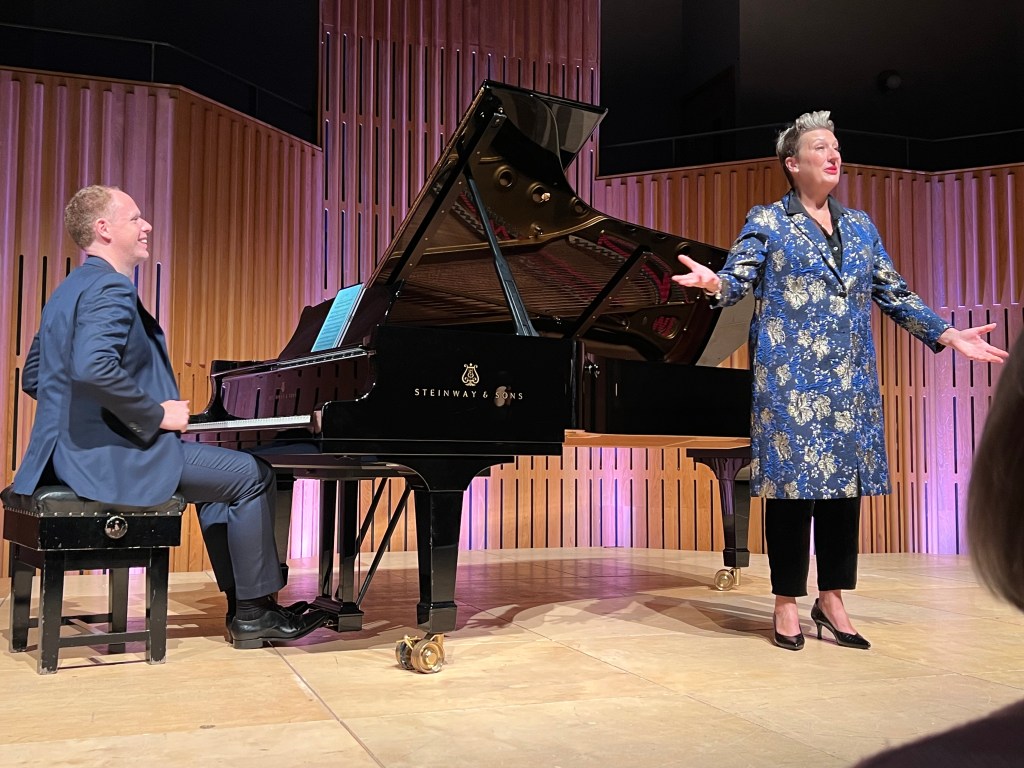
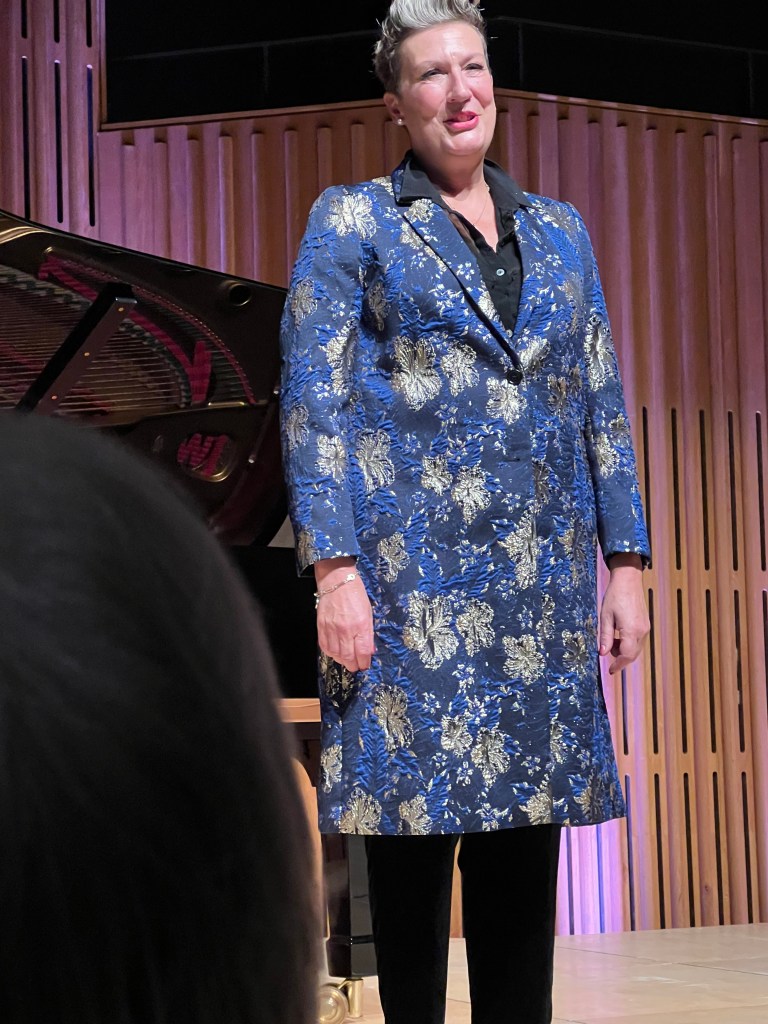
In the words of the song from South Pacific, there is nothing like a dame. If anyone needed proof then they should have been at Howard Assembly Room on 2nd October listening to Dame Sarah Connelly. She gave the most amazing performance of a variety of songs from Brahms to Weill. There was also the world premier of a piece commissioned by Leeds Lieder from Errollyn Wallen.
Dame Sarah is a world famous opera singer whose biography in the programme seems to cover every opera, every opera company and every music venue in the world. Although hailing from Durham she began the evening by saying how good it was to be back in Leeds where she had memories of being dropped off and collected by her father, after endless unsuccessful auditions!

The bulk of the programme comprised of lieder. For those not in the know, lieder is the German for ‘songs’ and is the plural of lied, pronounced lead, which I presume makes her an undisputed lieder leader. The songs are usually written to be performed by a singer and an accompanist, normally on piano, and tonight we had the superb Joseph Middleton in that role, who, although some of the works were rather deep, never seemed to stop smiling. He specialises in accompaniment and has worked with an incredible array of singers, including Roderick Williams, with whom I saw him perform last March. The next time I saw Mr Williams he was singing at the Coronation of King Charles III, on tv, obviously. Mr Middleton’s cv also reads like a cross between a classical music encyclopaedia and a travel guide to the cities of the world.
Lieder are songs which set poetry to music and differ from popular songs in that the main focus is not solely on the singer, but is shared with the musician. There are two types of lieder – I hope that you are paying attention as there is an exam to follow – strophic and through-composed. The first is when the different stanzas of poetry are set to the same repeated verse of music, whereas the second, you guessed it, is when each stanza is set to a different tune. Now, that wasn’t so difficult was it?
I must admit to finding the concert with Roderick Williams a little strange to the ear with the singer and the pianist following different paths, but that was eighteen months ago and I have become a little more used to it now. Dame Sarah’s voice, being a mezzo soprano, I found to be a little less harsh than Mr Williams’s tenor so more acceptable to the untrained ear, in fact both of them.
As I mentioned, the range was wide with works by Brahms, Mahler, Debussy and Weill as well as the premier of the Wallen which , in itself, was very varied. It comprised a cycle of four songs; the first, Sleep, used extracts from Shakespeare’s MacBeth. This was a more traditional lieder which I can only describe to my fellow newbies as being in the Whitney Houston/Maria Carey mould in that there seemed to be a compulsion to hit every note in the book. I always thought that the two popular singers mentioned must have Yorkshire ancestry as they appear to take the attitude that they have paid for all of the notes so they are blooming well going to use them. Sleep was obviously rather more deep than I Will Always Love You, and the two performers worked wonderfully well together.
The second part of the cycle was called Bright Lights and the text was written by Ms Wallen after being told that the jazz singer, Ella Fitzgerald, originally wanted to be a ballerina and this was an imagining of how the 17 year-old Ella would have felt having to sing for the first time at Amateur Night at The Apollo Theatre in Harlem, a performance which launched her career. As you would expect, this was a far more accessible piece to someone with my musical background and had more than a touch of the Porgy and Bess about it. Wonderful.
The third song, There’s a certain slant of light, is set to a poem by Emily Dickinson, and the final one, Night Thoughts, which gives its name to the whole cycle, again had a modern feel being based on one of Howard Hodgkin’s last paintings and composed after Ms Wallen heard Dame Sarah singing jazz whilst accompanying herself on piano.
The whole evening was a treat as I was pushed to understand some of the works, although the words were displayed on electric screens, but entertained by the more familiar format of a few of the pieces. Even the Weill included a song made famous by Edith Piaf, Je ne t’aime pas, or I Don’t Love You.
So, my musical education has taken another step forward, and I can’t wait for the next one.
To see what delights are in store at Howard Assembly Room, please go to https://www.operanorth.co.uk/event-tag/har/
Feature image provided by Opera North, photographs by Stan Graham

